Rare Earth Metals - Whitepaper
REE Targeting in Southern Namibia – Executive Brief
A satellite-driven exploration screen for the Kuboos-Bremen Line province
AI-Metals, Dr Minerva Singh
June 2026
The opportunity
Namibia hosts one of Africa’s most prospective REE landscapes, with four distinct deposit provinces and multiple Canadian-listed companies actively exploring its Damaraland, Otjozondjupa, and Kunene targets. The Kuboos-Bremen Line in the //Karas Region — a 270 km belt of Cambrian alkaline-carbonatite ring complexes hosting Marinkas Quellen, the only confirmed REE-bearing carbonatite on the line — is by contrast almost entirely unscreened for REEs at a modern technical standard. Marinkas Quellen itself has no operator currently attached to it on the national inventory. In commercial terms, the Karas REE province is open ground.
The capability
AI-Metals has developed an integrated multi-sensor satellite screening workflow for REE prospectivity, combining Sentinel-2 optical alteration mapping, Sentinel-1 radar texture analysis, and SRTM topographic analysis (including a custom ring-detection algorithm tuned to alkaline-complex morphology) into a single ranked prospectivity surface. The workflow uses public data only and runs end-to-end in Google Earth Engine, allowing large licence areas to be screened for a small fraction of the cost of conventional exploration.
The result
Applied to a 30 × 30 km area centred on Marinkas Quellen, the workflow recovered the known carbonatite as a high-prospectivity zone (calibration validated against a confirmed positive target) and identified a previously unmapped candidate target to the south-east. The new target exhibits all four signatures expected of a Kuboos-Bremen Line ring complex: circular topographic morphology, sericite-and-carbonate alteration response, alignment on the NE-SW regional structural trend, and emplacement in favourable Namaqua basement host terrain. In a province with only one named REE deposit currently on the national inventory, even one substantiated new target meaningfully expands the known footprint.
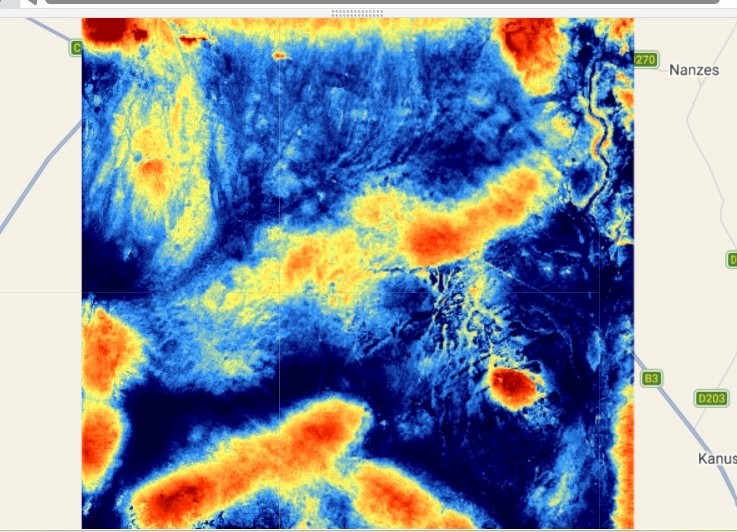
Integrated prospectivity surface over the Marinkas Quellen study area. The continuous NE-SW corridor of high-prospectivity zones is the structural expression of the Kuboos-Bremen Line. The compact, isolated red feature in the centre-right of the image is the principal new candidate target identified by the workflow.
The roadmap
The current workflow uses open-source satellite data only. Three staged upgrades using publicly available Namibian government data multiply its value:
• Airborne geophysics. Government-collected airborne radiometric thorium data directly detect REE-bearing minerals (monazite, allanite, REE-fluorocarbonates), unlike Sentinel-2 which only detects alteration halos. Airborne magnetics independently confirm ring-complex morphology.
• Lithological masking. The 1:250,000 government geology layer drops false positives in unsuitable host rocks, sharpening the target list.
• Supervised classifier. Training a classifier on the Namibian mineral occurrence database, validated against the operational Lofdal and Okorusu REE projects, replaces the current heuristic score with a calibrated probability surface defensible to technical stakeholders.
Why AI-Metals
The combination of open-source first-pass mapping with in-house LiDAR point-cloud and hyperspectral processing capability makes AI-Metals well positioned to take a target from satellite anomaly to drill-ready prospect at low cost. The methodology mirrors how mature exploration teams now structure their evidence stacks, but applies that approach in a province that has not yet been systematically screened. The result is both technically defensible (multi-evidence convergence, calibrated against known positives) and commercially actionable (clear AOI, identified candidate, unclaimed ground).
Next steps
The full technical methodology and case study are documented in a comprehensive white paper, "Multi-Sensor Satellite Screening for Rare Earth Element Prospectivity in Southern Namibia". To access this white paper please request through the contact us form.
Immediate operational next step: spectral fingerprint comparison of the south-east candidate against the known Marinkas Quellen body. Medium term: supervised-ML upgrade using the Namibian government datasets identified above. Longer term: in-house hyperspectral and LiDAR follow-up over the highest-ranked targets to confirm REE-bearing mineralogy and define drill-ready prospects.